September 24, 2026
The Right Approach to Planning Water Storage for Multi-Building Developments
Learn the right approach to planning water storage for multi-building developments:
Overview
- Commercial buildings in the Philippines often outgrow their water storage capacity because of rising occupancy, structural expansions, functional shifts, and concentrated peak-demand spikes.
- Even with sufficient tank volume, slow recharge rates or inadequate pump and piping infrastructure can cause shortages.
- Solutions include auditing usage, upgrading pumps, implementing conservation, and installing modular FRP/GRP tanks.
Water tanks in the Philippines are often sized to meet a commercial property’s needs at the time of planning or construction. The challenge is that an establishment rarely operates exactly as originally designed, because occupancy can increase, new facilities can be added, and everyday water use can rise.
This is why commercial buildings can outgrow their water storage capacity faster than expected. The problem isn’t always that the original tank was sized incorrectly. In many situations, the structure itself has changed beyond the assumptions used to determine its initial water demands.
A business space may have enough water storage based on its average daily consumption and still experience shortages during periods of concentrated demand. Consumption timing matters because many activities can draw from the same supply at once.
Some structures may see higher consumption when employees arrive and facilities fill up, while a hotel can see simultaneous need from guest rooms, restaurants, housekeeping, and other amenities.
These patterns become more significant as occupancy increases. A tank that was adequate when a building had fewer tenants may have less reserve capacity once more people use the same facilities.
Certain periods put more pressure on water storage than the everyday average suggests. Meal preparation, housekeeping, and cooling requirements can overlap, creating short durations of unusually high demand.
Configuring a system around average consumption alone can therefore misrepresent actual requirements. That’s why identifying peak-demand times is important when evaluating whether current storage remains adequate.
The incoming distribution rate, pipe size, pump capacity, and available water pressure all impact how quickly depleted storage can be restored. When demand temporarily exceeds the rate at which the tank replenishes, the available reserve continues to decline. Repeated high-demand periods can make an otherwise sufficient tank hard to keep full.
What begins as one type of property may eventually serve more tenants or add extra services, increasing water requirements without any corresponding change to the original storage infrastructure.
A change in structural function can have an even bigger impact. Converting office space into restaurants, adding food-service workflows, introducing fitness facilities, or increasing housekeeping requirements can substantially change water demand.
The original storage calculation may have been right for the past use but no longer reflects the building’s existing operations.
Physical expansion also increases demand. New floors, annexes, retail areas, or additional establishments introduce more fixtures and users that rely on the same water infrastructure.
If storage capacity remains unchanged as the development grows, the system must meet higher demand from the same reserve. Planning for expansion ahead of time can prevent this mismatch from becoming an operational issue.
You can’t assess storage capacity separately from the systems that move and supply water throughout a property. Even when a tank holds sufficient water, pumps, piping, and site conditions can prevent you from using that reserve.
Pumps may need to move bigger volumes of water within shorter timelines. If the current pump capacity doesn’t match the new requirement, water may not reach upper floors or distant areas at the required flow and pressure.
Piping restrictions can cause a similar concern. A larger tank alone won’t fix inadequate distribution if the downstream infrastructure cannot deliver the stored water where it’s needed.
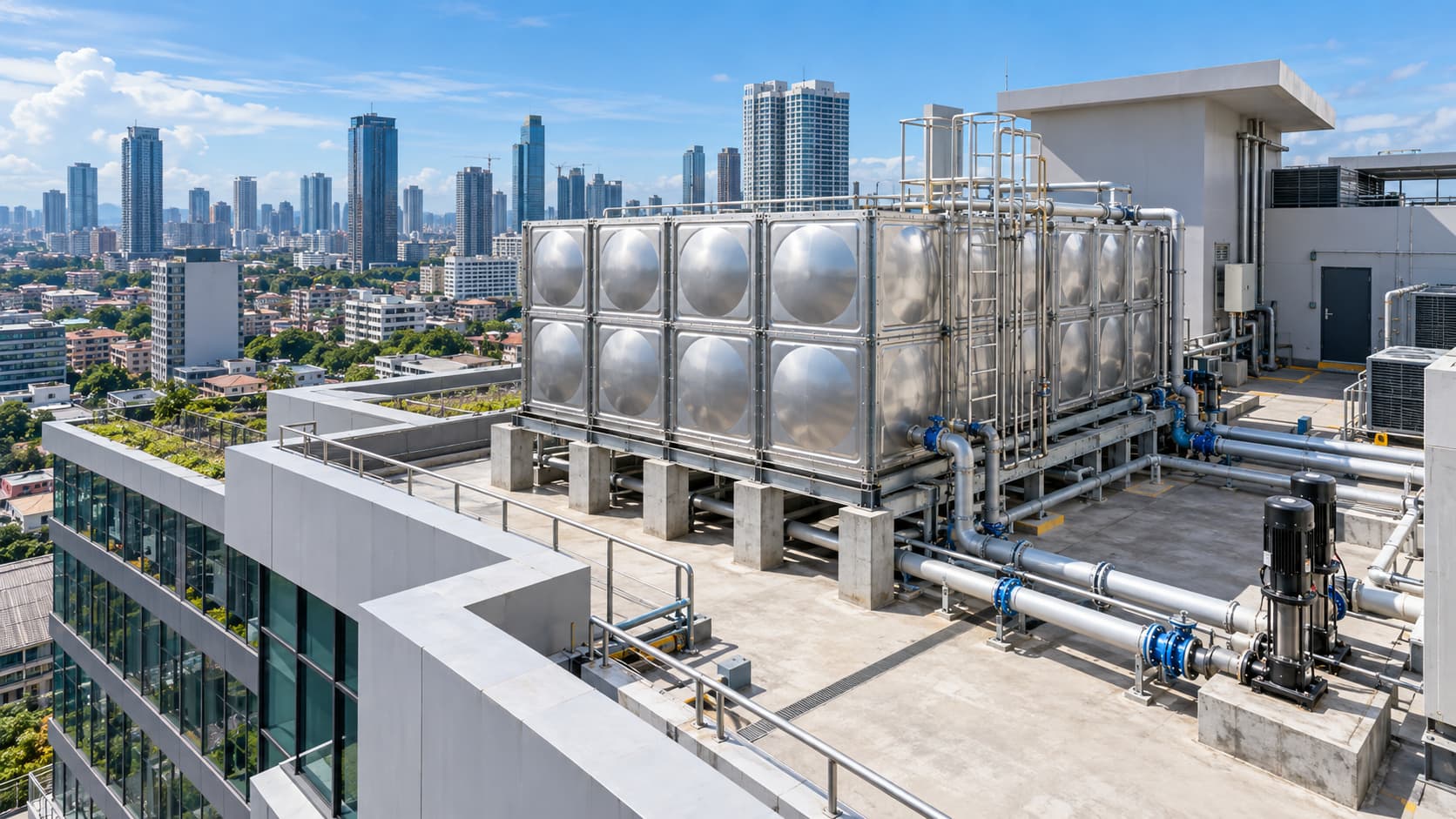
Current tanks may occupy a fixed space, while rooftops, mechanical rooms, basements, and utility areas have limited room for extra infrastructure. In these cases, enlargement can be challenging once a business property is already operating.
Installing a larger tank may call for structural modifications, equipment relocation, or significant disruption to existing workflows.
When demand exceeds the original storage plan, start with a careful evaluation. Understanding why the system is falling short determines whether you need more storage, better distribution, operational adjustments, or a combination of these measures.
Commercial properties rarely operate as originally designed, which explains why commercial buildings outgrow water storage capacity faster than expected. As tenant density rises, floor areas expand, and spaces are repurposed for water-intensive uses, overall demand increases. When these shifts align with concentrated peak-usage hours and pump limitations, original storage systems quickly become inadequate.
At Aqua Cube Tank, we build customized FRP/GRP modular water tanks tailored to your facility’s capacity, footprint, and operational layout. Contact us today to discuss the ideal storage solution for your property.
Learn the right approach to planning water storage for multi-building developments:
Find out what happens when your water storage capacity is insufficient and how Aqua
Find out why modular water tanks are becoming standard for new commercial properties