September 24, 2026
The Right Approach to Planning Water Storage for Multi-Building Developments
Learn the right approach to planning water storage for multi-building developments:
Overview
- Commercial developments face water storage issues such as corrosion, algae growth, space limits, and high maintenance costs.
- Fiber Reinforced Plastic (FRP) tanks solve these problems through their rust-resistant, light-blocking, lightweight, and modular design.
- FRP tanks lower lifecycle costs and deliver hygienic, expandable, and low-maintenance water storage tailored for long-term commercial needs.
Reliable water storage is essential to every commercial development. Whether it’s an office building, shopping mall, hotel, hospital, or mixed-use property, sufficient water supply supports daily operations, sanitation, and fire protection.
This is where Fiber Reinforced Plastic (FRP) tanks become really important. These are made from a strong composite material that combines durable plastic resin with reinforced glass fibers. In this article, we’ll explore the water storage challenges in commercial spaces and how FRP tanks address them.

Traditional metal tanks are constantly exposed to moisture, oxygen, and, in some locations, airborne salts or industrial pollutants. Over time, these elements react with metal surfaces, which weakens the tank structure. As corrosion progresses, buildings may face leaks, declining structural integrity, and increasing upkeep expenses.
Commercial properties store water for extended periods, creating conditions where microorganisms may grow if tanks are not properly maintained. Sunlight is also a primary contributor to algae growth. When light penetrates translucent or poorly sealed tanks, algae can develop inside the stored water. These conditions can affect water quality, increase cleaning frequency, and create additional maintenance responsibilities for facility management teams.
Commercial facilities often work within strict space limitations. From mechanical rooms and rooftops to podium levels and utility areas, these spaces can create design challenges because of the tanks’ weight and fixed dimensions. Bigger tanks may require extra structural reinforcement, and replacing or expanding existing systems can become difficult once a building is operational.
Water storage is meant to be a long-term investment, but maintenance demands can impact its overall expense. Tanks that require recurring repainting, corrosion repairs, coating replacement, or structural rehabilitation can drive up operational costs throughout their service life.
Beyond direct repair fees, upkeep tasks may also require temporary shutdowns or limited water usage that affect the structure’s operations. These indirect costs can exceed the tank’s initial purchase price.

FRP tanks are engineered to address the challenges of commercial water storage, offering durability, hygiene, and structural efficiency that support the evolving needs of modern buildings.
The composite construction of FRP tanks resists moisture, humidity, and corrosive environmental conditions without rusting. This inherent resistance makes FRP suitable for the Philippine tropical climate, where persistent rainfall, coastal exposure, and high humidity can accelerate the deterioration of subpar metal tanks. Instead of constantly dealing with corrosion, building owners can focus on regular inspections and preventive maintenance.
Many FRP tanks feature opaque panel layouts that block sunlight from entering the storage system. Limiting light exposure helps reduce conditions that promote algae growth, while the smooth internal surfaces make routine cleaning more efficient. Together, these properties contribute to cleaner stored water and lower upkeep needs throughout the tank’s service life.
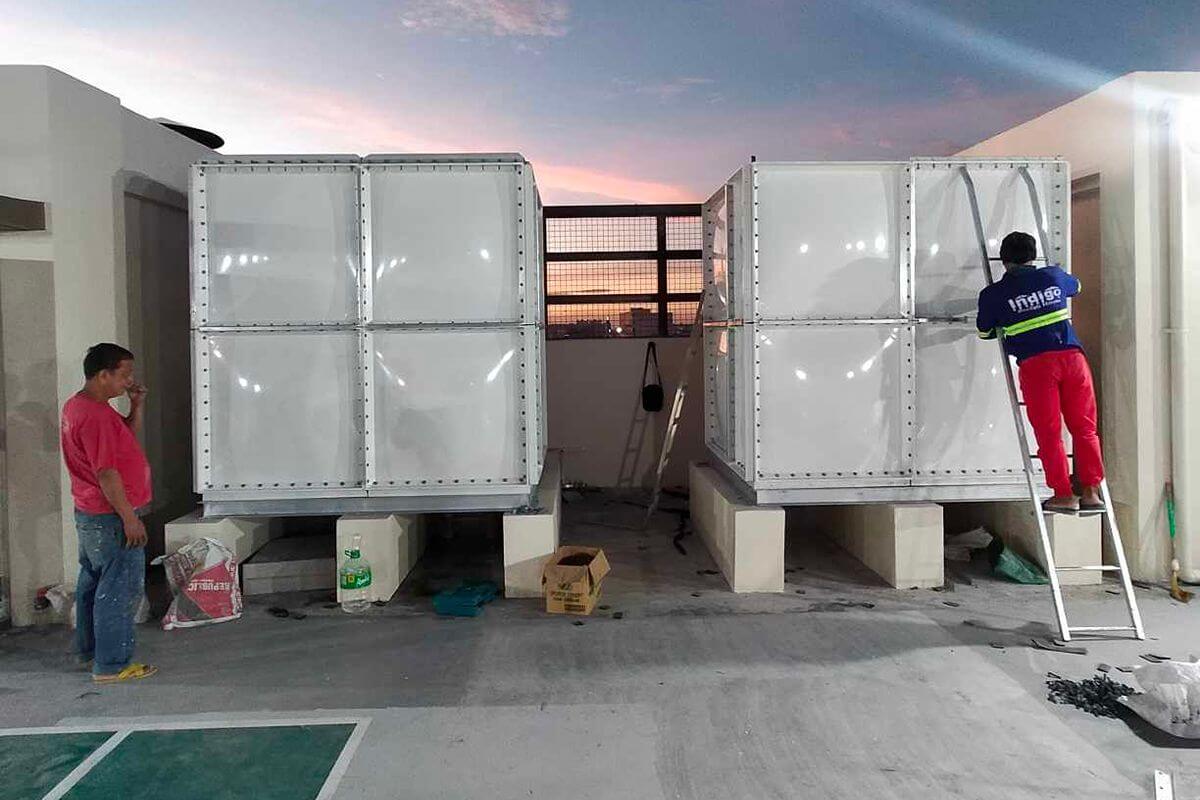
Compared to conventional construction products, FRP panels are more convenient to transport, handle, and assemble on-site, reducing installation complexity. Their modular construction also provides flexibility for commercial properties. Instead of replacing the whole system when demand increases, these water storage solutions can be configured or expanded to accommodate capacity demands.
Aqua Cube Tank supplies high-quality FRP modular water storage systems engineered to comply with the needs of commercial facilities in the Philippines. Our solutions integrate seamlessly into different site conditions while delivering dependable long-term performance. By combining quality materials with precision manufacturing, we help the right personnel to implement water tanks that remain practical as their projects evolve.
FRP tanks minimize lifecycle costs because of their corrosion-resistant properties, low maintenance requirements, and dependable structural performance over many years of operation. Their durability lets facilities spend less time resolving recurring maintenance issues and more time focusing on day-to-day operations.
Understanding water storage challenges and how FRP tanks address them allows property developers and architects to make more informed infrastructure decisions. From corrosion resistance to space efficiency and lower lifecycle costs, these tanks address operational challenges commercial developments face throughout their service life.
Aqua Cube Tank provides high-quality FRP modular water storage systems engineered for commercial, industrial, and institutional developments across the Philippines. Built for durability, our FRP tanks help facilities meet today’s operational requirements. Contact us today to learn more.
Learn the right approach to planning water storage for multi-building developments:
Find out what happens when your water storage capacity is insufficient and how Aqua
Find out why modular water tanks are becoming standard for new commercial properties