September 24, 2026
The Right Approach to Planning Water Storage for Multi-Building Developments
Learn the right approach to planning water storage for multi-building developments:
Overview
- Prepare thoroughly before selecting an FRP storage tank by documenting the stored media, operating temperatures, pressures, and specific gravity.
- Measure the required capacity, footprint, and installation clearances while planning the site foundation, containment, and logistics.
- Vet manufacturers for compliance and guidance to avoid costly mistakes; Aqua Cube Tank offers modular, corrosion-resistant FRP/GRP solutions and technical support for diverse applications.
Selecting the right FRP storage tank requires matching its design directly to your facility’s operational demands. Before purchasing, clearly define the chemical composition and specific gravity of the stored material, expected temperature and pressure levels, required storage capacity, and environmental conditions—including footprint, clearances, site foundations, and containment needs.
In this article, we’ll discuss what to prepare before choosing FRP storage tanks, ensuring you select a system capable of handling operational demands without further maintenance or future modifications.

One of the most important considerations when choosing an FRP storage tank is understanding what will be stored inside it. Although FRP delivers excellent resistance against many corrosive substances, not every resin system and tank configuration is suitable for all chemicals.
The chemical composition of the stored substance is based on factors like concentration, acidity, alkalinity, and exposure duration. Before selecting an FRP tank, provide comprehensive details about the stored media, including its chemical name, concentration level, and any additives or mixtures involved. Having this allows manufacturers to identify the right resin, reinforcement products, and protective layers necessary to maintain structural integrity.
Assessing the SDS provides crucial information about chemical properties and hazard requirements, determining whether the stored material may impact the tank’s structure or require more protective considerations. To prepare, project teams must prepare SDS documentation before finalizing tank specifications. That enables distributors to review compatibility and recommend an FRP system that complies with safety and operational standards.
Water storage should match the conditions under which it will operate. Temperature, pressure, and liquid characteristics can affect the structural performance and service life of an FRP storage tank.
Prepare the expected temperature conditions of the stored material during normal and peak operations. Record the minimum, maximum, and average operating temperatures, including any fluctuations that may happen during production cycles or seasonal shifts. Precise temperature data prevents you from choosing a subpar or premature degradation tank when exposed to conditions beyond its intended range.
Determine whether the tank will be utilized under normal atmospheric conditions or if it will experience pressure, vacuum, or other mechanical stresses during operation. To do this properly, take time to assess the process requirements, connected piping systems, pumping equipment, and any pressure transitions that may occur during filling or discharge. Sharing these specifications with the provider allows the tank design to align with the expected operating conditions.
Before choosing an FRP tank, distinguish the certain gravity of the liquid that will be stored. To do this, facilities can inspect product specifications, technical documents, or Safety Data Sheets (SDS) provided for the stored substance. This measurement presents how dense the stored product is compared to water and helps identify the amount of stress placed on the tank walls.
Tank capacity should factor in usage patterns, peak requirements, available installation space, and possible future expansion. Having these details ready allows suppliers to recommend a definite tank size.
For volume needs, make sure to prepare the necessary storage volume by identifying how much material needs to be stored, how frequently the tank will be filled, and how fast the contents are consumed or replaced. It’s also important to account for peak usage periods or unexpected increases in demand. Providing these guarantees that the selected system can consistently support operations.
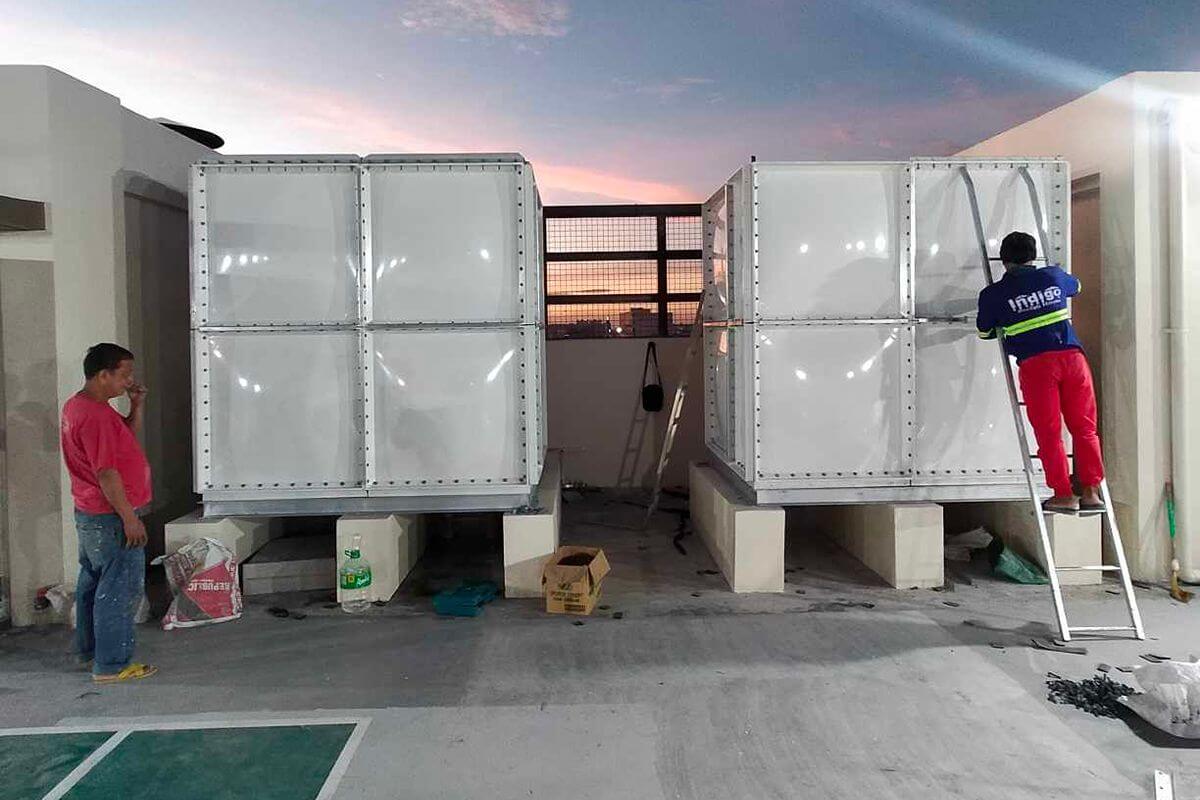
Take time to measure the dedicated area and check for the designated space and identify any physical limitations. Consider the tank’s required footprint, nearby equipment, piping connections, access points, and clearance for maintenance. A proper site measurement should include not only the space where the tank will sit but also enough room for installation activities and future servicing.

Preparing the installation site is one of the most important things businesses should keep in mind. Before finalizing a water storage solution, it’s best to evaluate site conditions that may impact stability and installation precision.
Check whether a vertical or horizontal configuration greatly suits the site layout and operational setup. Assessing the piping locations, maintenance access, and surrounding structures beforehand also helps ensure that the tank can be properly integrated into the facility’s current system.
Prepare information about the installation surface and structural support available at the site. The foundation must be capable of supporting the full weight of the tank when filled, as uneven or insufficient support can create stress on the tank structure over time.
For facilities storing chemicals or potentially hazardous materials, evaluate whether secondary containment is required. Preparing containment requirements early helps improve safety and ensures the installation complies with operational and environmental considerations.
Ensure how the unit will be delivered, moved, and installed within the facility. To do this, check access routes, doorways, pathways, lifting policies, and available equipment to know whether the site can accommodate the installation process. Getting ahead of these logistics concerns can prevent delays, and allows the installation team to plan the most effective strategy.
A reliable distributor must provide technical expertise, quality materials, precise fabrication standards, and end-to-end project support. Aqua Cube Tank delivers professional-grade FRP/GRP storage solutions engineered for durability and corrosion resistance. Our team guides project managers in evaluating application requirements, selecting optimal materials, and installing custom modular water storage systems across residential, commercial, and industrial sectors.
By working with experts like Aqua Cube Tank, structures can ensure that FRP tanks are not only built based on specifications but also supported by proper technical guidance from planning through installation.
Understanding what to prepare before choosing FRP storage tanks allows project teams to make better decisions. Assessing chemical compatibility, temperature demands, storage capacity, site conditions, and supplier capabilities ensures that the tank can provide optimal performance throughout its service life.
Aqua Cube Tank offers durable FRP/GRP storage solutions to comply with the needs of modern structures. With quality materials, technical expertise, and customized modular tank options, we support affiliates to choose the best storage systems. Reach out to us today to learn more.
Learn the right approach to planning water storage for multi-building developments:
Find out what happens when your water storage capacity is insufficient and how Aqua
Find out why modular water tanks are becoming standard for new commercial properties