September 24, 2026
The Right Approach to Planning Water Storage for Multi-Building Developments
Learn the right approach to planning water storage for multi-building developments:
Overview
- Unlike traditional steel tanks, which require regular maintenance and protective coatings to prevent rust, Fiber Reinforced Plastic (FRP) tanks offer inherent corrosion resistance.
- Built from non-conductive glass fibers and resin, FRP tanks resist chemical damage, moisture, and salt exposure, providing superior longevity and reliable, low-maintenance water storage.
Traditional steel tanks have long been used because of their strength and structural reliability. However, steel is naturally vulnerable to corrosion when exposed to moisture, chemicals, and oxygen. To protect against deterioration, many steel systems require additional coatings, protective layers, or regular maintenance to preserve their condition.
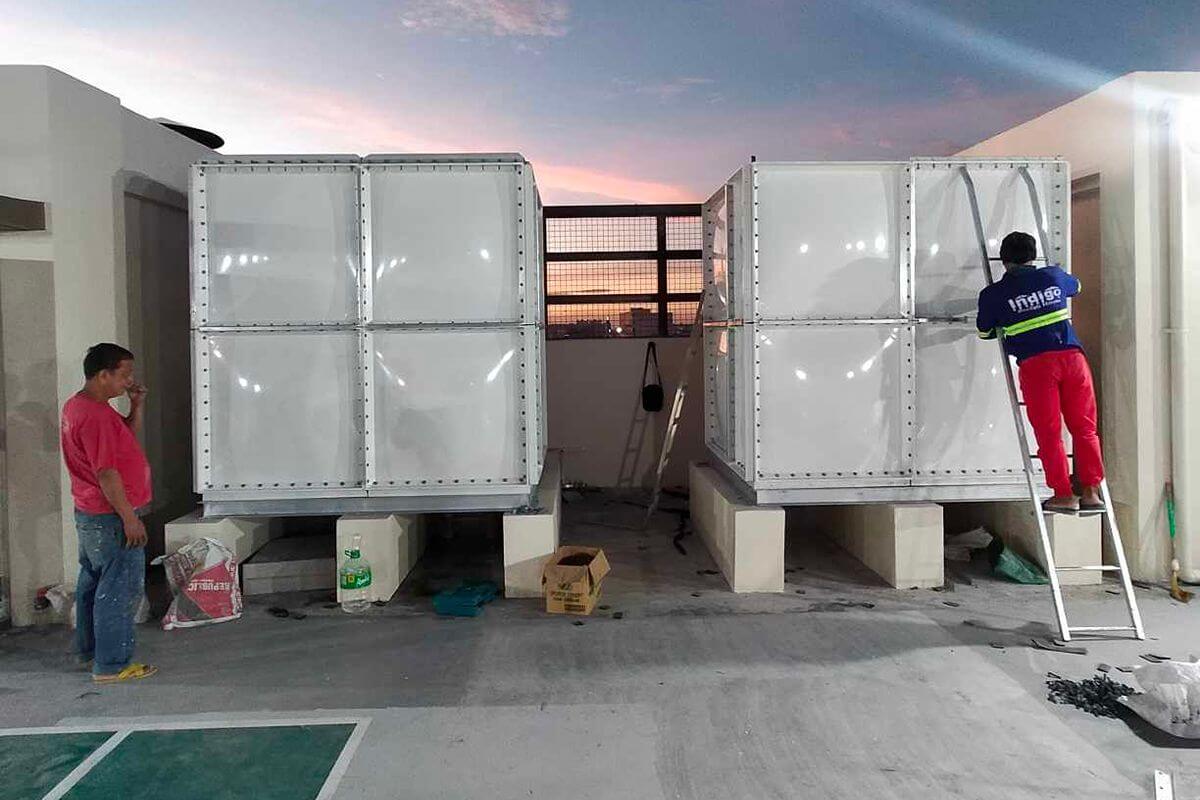
This is where Fiber Reinforced Plastic (FRP) tanks provide an advantage. Built from composite materials that combine plastic resin with reinforced glass fibers, FRP tanks are designed to resist corrosive conditions without relying heavily on external protective treatments.
See why FRP tanks perform better in corrosive environments than traditional steel.

The primary reason FRP tanks perform well in corrosive environments is their natural resistance to corrosion. Unlike steel, which can oxidize when exposed to water and air, FRP is a composite material that does not rust or deteriorate through traditional corrosion processes.
FRP tanks address this issue because their corrosion-resistant properties are integrated into the material itself. The composite structure creates a durable barrier that helps protect stored water from contamination and reduce reliance on additional protective layers. This also simplifies maintenance needs, as facilities can focus on system inspections.
Many traditional steel tanks require protective coatings or internal linings to prevent water from contacting the metal surface. While these protective layers can extend tank life, they may eventually wear down due to abrasion, chemical exposure, or repeated use.
FRP tanks address this issue because their corrosion-resistant properties are integrated into the material itself. The composite structure creates a durable barrier that helps protect stored water from contamination and reduces reliance on additional protective layers. This also simplifies maintenance needs, as facilities can focus on system inspections.
A water storage tank is a long-term investment, making durability a key consideration during project planning. In corrosive environments, a tank’s lifespan depends not only on structural strength but also on how well it resists continuous exposure to damaging elements.
FRP tanks maintain their performance because their materials are designed to resist rust, chemical reactions, and environmental deterioration. Their lightweight yet rigid construction helps maintain structural integrity while reducing issues commonly associated with metal corrosion.
Another advantage of FRP tanks is their electrical non-conductivity. Unlike steel, which can conduct electricity, FRP does not allow electrical currents to pass through its structure.
This characteristic provides protection in environments with electrical exposure, chemical processes, or specialized industrial operations. Since FRP does not contribute to galvanic corrosion—a process where metals deteriorate due to electrical interactions between different materials—it maintains material stability over time.

Choosing the right tank material is only one part of ensuring reliable water storage performance. Proper design, fabrication quality, and installation expertise also impact how a tank performs throughout its service life.
Aqua Cube Tank provides high-quality FRP/GRP tank solutions designed for projects requiring durability, corrosion resistance, and long-term reliability. Our FRP tanks are built with reinforced composite materials that provide structural strength while resisting harsh environmental conditions. Designed for residential, commercial, and industrial applications, these systems offer a practical solution for facilities that need dependable water storage in challenging environments.
Understanding why FRP tanks perform better in corrosive environments than traditional steel comes down to the differences in material properties. While steel relies on protective coatings and maintenance to manage corrosion risks, FRP provides inherent resistance through its composite construction.
Aqua Cube Tank delivers reliable FRP/GRP water storage solutions designed to meet the performance requirements of modern facilities. With expertise in modular tank systems and high-quality materials, we help engineers, contractors, and developers select storage solutions that support long-term operational needs. Contact us today to learn more!
Learn the right approach to planning water storage for multi-building developments:
Find out what happens when your water storage capacity is insufficient and how Aqua
Find out why modular water tanks are becoming standard for new commercial properties